
The Holy Grail: Esoteric Origins, Sacred Lineages, and a Hidden Journey Through Europe
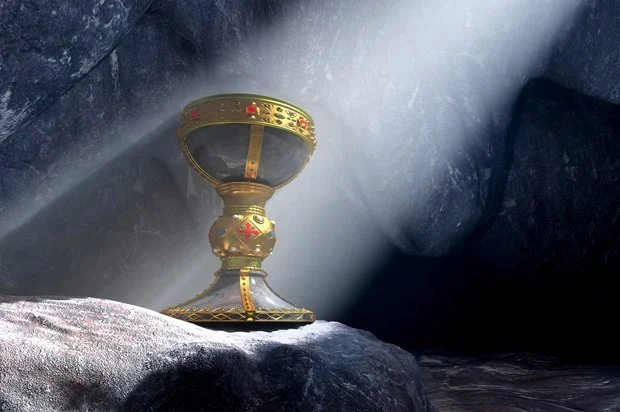
The Holy Grail, also known as the Holy Chalice, is one of the most enduring and enigmatic relics in Western spiritual tradition. Often described as a vessel endowed with miraculous powers — capable of healing, sustaining life, or granting divine wisdom — the Grail occupies a central place where myth, mysticism, and sacred history converge.
Best known through Arthurian legend, the Holy Grail became a powerful symbol of spiritual attainment, secrecy, and divine inheritance. Yet long before medieval romances, the Grail already existed within far older traditions — both biblical and esoteric.
The Holy Grail in Christian Tradition
In Christian theology, the Holy Grail is commonly identified as the cup used by Jesus at the Last Supper, when He shared wine with His disciples as the symbol of a new covenant. The Synoptic Gospels recount this moment, with the Gospel of Matthew describing it as follows:
“And He took a cup, and when He had given thanks He gave it to them, saying, ‘Drink this, all of you; for this is My blood of the covenant, which is poured out for many for the forgiveness of sins.’”
— Matthew 26:27–29
This passage firmly anchors the Grail within the Christian narrative — yet esoteric traditions suggest its origins extend far beyond the surface-level account.
Esoteric Origins: Shamballah, Agartha, and the Inner Earth
Within esoteric cosmology, the Holy Grail is not merely a historical object, but a transdimensional relic said to originate in Shamballah, the spiritual seat of Agartha within the Inner Earth. From this perspective, the Grail periodically enters and exits the physical world, appearing only at pivotal moments of spiritual transformation.
According to these traditions, the Grail acts as a conduit — a vessel capable of anchoring higher-dimensional forces into the material realm.
Abraham, Melchizedek, and the First Appearance of the Grail
Esoteric traditions place the Grail’s earliest appearance in our three-dimensional world during the time of Abraham. After his victory over the kings of Sodom and Gomorrah, Abraham encountered Melchizedek, the mysterious priest-king of Salem — later Jerusalem.
The Book of Genesis describes Melchizedek bringing bread and wine, blessing Abraham, and receiving tithes. Esoteric interpretations identify Melchizedek as a guardian of ancient knowledge — sometimes referred to as the Genie of the Earth — who entrusted Abraham with the Holy Grail following their sacred rite.
This encounter establishes the Grail as a relic tied not only to Christianity, but to a much older priesthood predating the Mosaic law.
King Solomon and the Queen of Sheba
Centuries later, the Grail resurfaces in traditions surrounding King Solomon. The biblical account describes the visit of the Queen of Sheba, who came to Jerusalem bearing immense treasures and testing Solomon with profound riddles:
“The Queen of Sheba came to Jerusalem with a very great retinue… to prove him with hard questions.”
— 1 Kings 10:1–2
Esoteric sources claim that among the treasures she presented was the Holy Grail itself, from which Solomon drank. Alongside the Ark of the Covenant, the Grail was regarded as one of Solomon’s most powerful sacred objects — instruments of wisdom, authority, and divine connection.
The Grail, the Crucifixion, and Joseph of Arimathea
The Grail reappears in the Christian era as the cup used by Jesus at the Last Supper. Esoteric tradition continues the story beyond the canonical Gospels, claiming that Joseph of Arimathea later used the Grail to collect the blood flowing from Jesus’ wounds at Golgotha.
After the crucifixion, Joseph — assisted by Nicodemus — prepared Jesus’ body for burial, as described in the Gospels. What follows, however, is preserved in apocryphal texts such as the Gospel of Nicodemus, which recounts Joseph’s imprisonment by the Jewish elders and his miraculous liberation by the resurrected Christ.
According to this account, Jesus appeared to Joseph, transported him beyond physical confinement, and returned him safely to his home — an event esotericists interpret as an example of transdimensional or Jinn-like travel, enabled by Christ’s resurrected state.
The Grail’s Journey Across Europe
Following these events, Joseph of Arimathea is said to have carried the Holy Grail westward. Tradition places him first in Rome, during the persecutions under Nero, before he journeyed along the Mediterranean.
Guided by an angelic vision, Joseph eventually reached the mountains of Montserrat, where he concealed the Grail within a hidden sanctuary. Over time, a sacred temple formed around it — visible only to pilgrims of purity and spiritual readiness.

The Montserrat Monastery in Catalonia, Spain.
As humanity’s spiritual state declined, the Grail and its sanctuary were said to withdraw from the physical world, entering the fourth dimension, remaining accessible only to those capable of inner vision or astral travel.
France, the Grail, and What Comes Next
At Ancient Mysteries Expedition, I believe this story — or at least part of it. I am also convinced that the Holy Grail passed through France, leaving traces embedded in landscape, legend, and suppressed history.
That chapter — involving sacred sites, hidden lineages, and the Cathar connection — will be explored in the next post.
If this subject resonates with you, you’re already closer to the mystery than you might think.